Spelling And Grammar

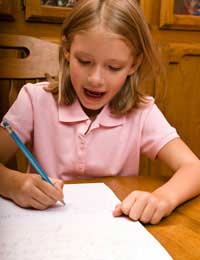
Lots of children find spelling and grammar hard and this can decrease the pleasure that they derive from writing. Reading, writing, spelling and grammar are all interrelated and are taught as an integrated part of the Key Stage 1 literacy program.
Spelling
Most children need direct spelling instruction. When children first begin to deal with letter-sound associations they use a process called ‘invented spelling’. This is when they use their letter-sound knowledge to try to spell a word when the correct spelling is not known. This can be very useful for a time, but as their learning progresses they must also be taught to spell words correctly.Grammar
Grammar is the set of rules that governs a language or a set of guidelines that explains how a language works. Grammar is essential for clear communication and is what gives sense to a language. Your child will be learning grammar usage such as parts of speech, punctuation rules etc. Writing, spelling and grammar are closely connected and are all taught in relation to each other and to reading.The first grammar your child will learn is by example. Sentence structure, pronoun use and verb use are all learnt through hearing people speaking correctly. However, if poor speech is modelled, this is what your child will learn. Grammar is mainly learnt through observation and through personal reading.
Helping your Child
The following are some tips for teaching your child spelling and grammar:- Encourage your child to pay attention to the spelling of words as they read. Provide your child with a simple children’s dictionary and get your child to look up unfamiliar words as they come across them.
- Make it in to a game for your child, such as forming anagrams out of their name or other common words.
- Encourage your child to always proofread their work for spelling and grammar mistakes. When using a computer the spell checker can be very useful but they is still no substitute for human proofreading.
- Language arts songs that teach grammar, punctuation and spelling can be found on the Internet. Many of these can be listened to online or you can purchase the download or CD.
- Give your child old newspapers or magazines to play word-finding games. These games can be made harder as your child’s learning progresses.
- There are many free English spelling and grammar teaching tools online. No matter what age or level your child is, you should be able to find suitable tutorials, worksheets and fun activities that you can do with your child to reinforce what they are learning in school.
- Always read over your child’s homework when they are finished and point out spelling and grammar mistakes as you find them. Discuss what was wrong, what it should have been, and why.
Related Articles in the 'Infants KS1' Category...
- Speaking and Listening: Storytelling
- Science: Living Things
- Reading: Traditional And Fantasy Stories
- Learning About Writing
- Learning about Shapes
- Citizenship: Money
- Using Flashcards
- RE: Bible Stories
- PSHE: Good Manners
- Infants: Recognising Colours
- Numbers: Number Bonds
- Citizenship: Bullying
- History: Famous Inventors
- ICT: Word Processing

Re: Speaking and Listening: Storytelling
nice
Re: Starting a Homework Club
Hi I resently start with a homework club do I need to be rgister at socail workers and go to all that proces please need some at advice
Re: Starting a Homework Club
I'm trying to start a homework club business in my community. I wish I could get a mentor who would assist me step by step to achieve…
Re: Starting a Homework Club
Hello, I’ve recently opened my own private after school homework club but I could do with a lot of guidance (Perhaps a mentor) to help…
Re: Starting a Homework Club
Thank you for your info I set up one in my church as I see many struggling maths and science students From just a few we have grown…
Re: How Much Homework Should Your Child Be Getting?
My daughter has just started year 7. She can get 2-4 pieces of home work per day each from 30-45 mins…
Re: How Much Homework Should Your Child Be Getting?
My 8 year old (year 3) daughter gets almost no homework. We are ,and always have, pushed her to succeed,…
Re: How Much Homework Should Your Child Be Getting?
My daughter moved to secondary school in Wales in January 2019. Since then she has had one or two pieces…
Re: Keeping a Homework Diary
I love school I have been told I could go on this app to do homework ??!!
Re: How Much Homework Should Your Child Be Getting?
Are these comments a Joke! My son gets very little home work in year 10 and what he does get he…